
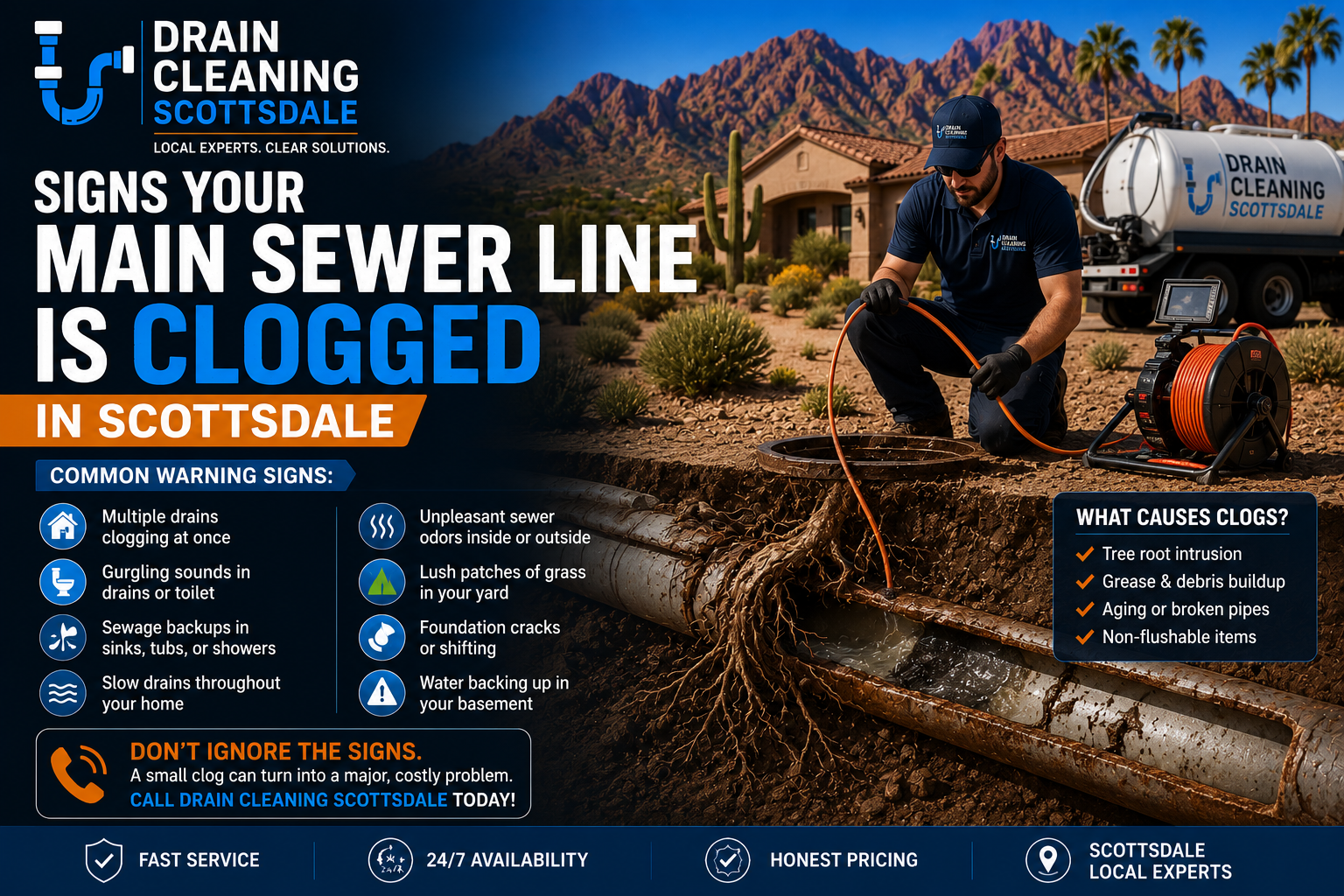
If you have lived in Scottsdale for any length of time, you already know the desert is hard on plumbing in ways that homeowners in wetter climates never have to think about. Mineral heavy water, shifting caliche soil, and mature landscaping with aggressive root systems all put steady pressure on the pipe that carries wastewater away from your home. That pipe is your main sewer line, and when it clogs, the problem rarely stays isolated to one fixture. Learning to recognize sewer line clogged signs Scottsdale homeowners run into most often can save you thousands of dollars and a genuinely unpleasant cleanup.
At Drain Cleaning Scottsdale, we get calls from homeowners across Scottsdale Ranch, the Shea Corridor, and the Cactus Corridor every week who assumed they had a simple clogged toilet or a slow bathroom sink, only to discover the real issue was several feet underground. This guide walks through the sewer line clogged signs Scottsdale residents should watch for, why Scottsdale properties are especially prone to them, and what to do once you spot the symptoms.
Understanding the Difference Between a Drain Clog and a Sewer Line Clog
Every home has a network of drain lines that function like the branches of a tree. Your kitchen sink, bathroom sinks, showers, and toilets each have their own branch line, and all of those branches eventually feed into a single trunk line, the main sewer line, which carries everything out to the municipal sewer connection or a private septic system.
A clog in a branch line is annoying but contained. If your bathroom sink drains slowly while everything else in the house works fine, you likely have a localized blockage that a plunger or a simple auger can clear. A clog in the main line is a different animal entirely. Because every fixture in the home ties into that single trunk, a blockage there affects multiple drains at once, sometimes in ways that seem unrelated until you understand how the system is connected.
This distinction matters because it changes both the urgency and the solution. Localized clogs are typically a same day fix. Main line clogs almost always require professional sewer line cleaning equipment, and ignoring them can lead to sewage backing up into your home, which is both a health hazard and a significant cleanup expense.
Sign 1: Multiple Drains Are Slow or Backed Up at the Same Time
This is the single clearest indicator of a main sewer line problem, and one of the most common sewer line clogged signs Scottsdale plumbers get called out for. If your kitchen sink is draining slowly on the same day your shower is backing up and your toilet is gurgling, that is not a coincidence. A single slow fixture usually points to a local blockage close to that drain. When two or more fixtures act up simultaneously, especially fixtures that are not physically close to one another, the shared point of failure is almost always downstream in the main line.
Homeowners in older sections of the Cactus Corridor near the Airpark business district sometimes notice this pattern first in a bathroom that shares plumbing with a kitchen renovation. If you flush a toilet and hear the washing machine drain gurgle in response, that is your main line telling you it is struggling.
Sign 2: Gurgling Sounds Coming From Drains
Gurgling happens because of air displacement. When wastewater tries to move through a partially blocked main line, it cannot flow freely, so air gets trapped and pushed back through the system, bubbling up wherever it can escape, usually a toilet or a floor drain. If you flush the toilet and hear bubbling from the tub or shower drain, water is being blocked downstream and is forcing air backward through the path of least resistance.
This is one of the earliest sewer line clogged signs Scottsdale homeowners notice, and it is worth paying attention to even if nothing has actually backed up yet. A partial blockage today becomes a full blockage surprisingly fast, particularly once monsoon season adds extra groundwater and runoff to the equation.
Sign 3: Water Backs Up in Unexpected Places
This is the sign that finally gets most homeowners to call a plumber. You flush the toilet and water rises in the shower. You run the washing machine and the floor drain in the laundry room overflows. You wash a load of dishes and the toilet water rises instead of draining calmly.
Whenever using one fixture causes water to appear somewhere else, wastewater is being blocked from leaving the home through its normal path and is finding the next lowest point to escape instead. Gravity always wins, so the lowest drain in your home, often a laundry room floor drain or a downstairs bathroom, will usually be the first place you see this.
Sign 4: Sewage Odor From Multiple Fixtures
A single smelly drain might just need a good cleaning, and this is common in Scottsdale homes where hard water minerals combine with soap scum to create odor causing buildup in P traps. But when a sewage smell is coming from more than one drain, or from an area with no obvious source like a yard or a side patio, that points to a blockage further down the line where wastewater is sitting and beginning to break down instead of flowing out normally. This is another one of the classic sewer line clogged signs Scottsdale homes reveal before a full backup happens.
Sign 5: Standing Water or Unusually Green Patches in the Yard
Because main sewer lines run underground, problems there are not always visible until they surface, literally. If you notice a soggy patch of lawn, a section of yard that stays wet long after the sprinklers run, or grass that is suspiciously greener and lusher than the surrounding landscaping, that can be a sign the main line has cracked or is leaking near the surface. In neighborhoods like Scottsdale Ranch, where mature trees line many properties, root intrusion is a frequent cause of these slow leaks, since roots are drawn toward the moisture and nutrients inside a sewer line and will exploit even small cracks over time.
Sign 6: Drainage or Bubbling at the Sewer Cleanout
Most homes have a sewer cleanout, a capped pipe usually located near the foundation or in the yard, that gives plumbers direct access to the main line. If you notice water pooling around the cleanout cap, or if removing the cap (carefully) reveals water sitting close to the top, that is a strong indicator the main line downstream is blocked and wastewater has nowhere left to go.
Why Scottsdale Properties Are Especially Prone to Main Line Clogs
A few local factors make main sewer line clogs, and the sewer line clogged signs Scottsdale properties display, more common here than in many other parts of the country.
Hard water mineral buildup. Scottsdale’s water supply carries a high mineral content, and over years that mineral scale narrows the interior diameter of sewer pipes the same way it narrows the inside of a kettle. Narrower pipes catch debris more easily and clog faster.
Mature landscaping and aggressive root systems. Many established neighborhoods across the Shea Corridor and Scottsdale Ranch feature large trees planted decades ago, and their root systems have had plenty of time to find their way into aging clay or cast iron sewer lines.
Desert soil movement. Caliche and expansive soils shift with seasonal moisture changes, and that shifting can put stress on pipe joints, creating small offsets where debris collects and eventually forms a full blockage.
Grease and food waste habits. Kitchen grease that is poured down the drain does not disappear. It cools, hardens, and coats the inside of pipes, gradually narrowing the passage until a main line clog forms downstream. If your kitchen sink has been fighting you for months, it is worth reading our companion guide on why your kitchen sink keeps clogging for the habits that quietly cause this.
What to Do If You Suspect a Main Line Clog
If you notice two or more of the signs above, the safest move is to stop using water fixtures until the line has been inspected. Continuing to run water through a blocked main line increases the risk of a backup finding its way into your home.
Professional sewer line cleaning uses equipment like motorized augers and hydro jetting to clear blockages without the guesswork of DIY chemical treatments, which can actually damage older pipes and are not effective against tree roots or mineral scale. A camera inspection can also confirm exactly where the blockage sits and whether the line itself has sustained any cracking that will need repair down the line.
For homes on a septic system rather than a municipal sewer connection, similar backup symptoms can also point to a septic tank nearing capacity rather than a simple line blockage, which is why routine septic tank cleaning is worth scheduling on a regular interval rather than waiting for symptoms to appear.
And if the underlying issue traces back to a commercial kitchen or a home with heavy cooking habits, grease trap cleaning addresses the buildup at its source before it ever reaches the main line.
Prevention Tips for Scottsdale Homeowners
A little routine maintenance goes a long way toward avoiding an emergency call.
Schedule a camera inspection every couple of years, especially if your home was built before the 1990s and likely has clay sewer piping. Avoid pouring grease, coffee grounds, or starchy food scraps down any drain in the house. Keep an eye on tree placement relative to your sewer line, and consider a root barrier if a mature tree sits close to the pipe path. During monsoon season, watch for slow drains developing more quickly than usual, since extra groundwater can accelerate an existing partial blockage into a full one.
Serving Scottsdale Ranch, the Shea Corridor, and the Cactus Corridor
Because so many homes in this part of the Phoenix metro were built during similar development eras, we see recurring patterns of main line issues by neighborhood. Homes around Scottsdale Ranch often deal with root intrusion from mature landscaping near the lake areas. Properties along the Shea Corridor tend to see more mineral scale buildup given the age of the municipal lines in that stretch. And commercial properties and townhomes in the Cactus Corridor near the Airpark frequently combine kitchen grease issues with standard line wear, which is why we often recommend pairing sewer line cleaning with grease trap service for property managers in that area.
Monsoon Season and Main Line Clogs
Scottsdale’s monsoon season brings a specific risk that homeowners in drier months rarely think about. Heavy, sudden rainfall raises the water table temporarily and forces extra groundwater toward buried sewer lines, especially in older neighborhoods where clay piping has settled or shifted over the decades. A main line that has been coping with a partial clog for months can go from a mild nuisance to a full backup within a single storm, simply because the line now has to move more volume than usual through an already narrowed pipe.
This is also the time of year we see the most calls related to root intrusion. Established trees respond to sudden rainfall by sending roots aggressively toward any available moisture source, and a sewer line with even a hairline crack is an easy target. If your home has gone through a summer storm and you noticed slower drains afterward that never quite returned to normal, that timing is not a coincidence, and it is worth having the line inspected before the next storm arrives.
What a Professional Sewer Line Inspection Actually Involves
Homeowners often assume a sewer line problem means immediate digging and a torn up yard, but that is rarely the first step. A proper inspection starts with a small camera fed directly into the line through an existing cleanout or a fixture connection. That camera lets a technician see the interior of the pipe in real time, identify exactly where a blockage sits, and determine whether the issue is loose debris, root intrusion, mineral scale, or an actual structural crack or offset in the pipe itself.
From there, the fix depends entirely on what the camera shows. A blockage from grease, soap scum, or general debris typically responds well to hydro jetting, which uses highly pressurized water to scour the interior of the pipe clean without damaging it. Root intrusion may require a combination of mechanical cutting and hydro jetting, followed by a root treatment to slow regrowth. Structural damage, such as a cracked or offset pipe section, is the only scenario that typically requires excavation, and even then modern trenchless repair methods can often address a damaged section without digging up an entire yard.
Frequently Asked Questions
How much does a main sewer line clog cost to fix? The cost depends heavily on what the camera inspection reveals. A straightforward hydro jetting service to clear grease or debris buildup is far less expensive than a repair involving root intrusion or a damaged pipe section, which is why an inspection is always the right first step before assuming the worst.
Can I clear a main sewer line clog myself? Store bought chemical drain cleaners are not designed for main line clogs and can cause real damage to older pipes, particularly clay or cast iron lines common in established Scottsdale neighborhoods. A drain snake purchased at a hardware store also typically lacks the reach and cutting power needed to clear a true main line blockage. Professional equipment exists for a reason here.
How often should I have my sewer line inspected? For homes built before the 1990s, a camera inspection every two to three years is a reasonable interval, especially if mature trees are near the line’s path. Newer homes with PVC piping are less prone to root intrusion but can still develop grease or mineral buildup over time and benefit from periodic hydro jetting as preventive maintenance.
Is a main sewer line clog covered by homeowners insurance? Coverage varies widely by policy and by the cause of the clog. Damage caused by a sudden event, like a pipe bursting, is more commonly covered than gradual wear from root intrusion or mineral buildup, which most policies treat as a maintenance issue. It is worth reviewing your specific policy or asking your insurer directly before assuming either way.
What is the difference between a sewer line clog and a septic tank problem? The symptoms can look nearly identical from inside the house, since both cause slow drains and backups throughout the home. The distinction matters for the fix, since a full septic tank needs pumping and cleaning rather than line clearing. If your home is on a septic system and you are seeing these symptoms, it is worth having both the tank and the line checked in the same visit.
Call Drain Cleaning Scottsdale Before a Small Clog Becomes a Big Mess
If you are seeing any of the sewer line clogged signs Scottsdale homeowners report most, do not wait for a full backup to call for help. Our team provides camera inspections, hydro jetting, and full sewer line cleaning across Scottsdale and the surrounding Phoenix metro, with technicians who know the specific soil, water, and landscaping conditions that cause line problems in this area. Call us at +1 (480) 919-8331 to schedule an inspection or same day service.