Is the HOA responsible for sewer damage from common area tree roots? It depends on where the damage occurred and what your HOA’s governing documents say. Generally, homeowners are responsible for the sewer lateral running from their house to the property line, while the HOA or municipality may be responsible for issues in shared common areas or the main line beyond that point. This is general information, not legal advice, so reviewing your specific CC&Rs or speaking with an attorney is the only way to know for certain in your situation.
If you live in a Scottsdale, AZ community with an HOA and just discovered tree roots have caused a sewer backup, you are probably wondering exactly who is on the hook for the repair bill. As a local drain cleaning professional who has worked with homeowners throughout communities like DC Ranch, I can walk you through how this typically breaks down and what steps actually help you sort out responsibility, even though the final answer always depends on your specific documents and local rules.
What Is a Sewer Lateral
A sewer lateral is the section of pipe that runs from a home’s plumbing system to the main sewer line, typically crossing under the yard and sometimes extending into a shared easement or right of way before connecting to the municipal system.
How Responsibility Typically Breaks Down
While every HOA and municipality has its own specific rules, a few general patterns show up often enough to be worth understanding.
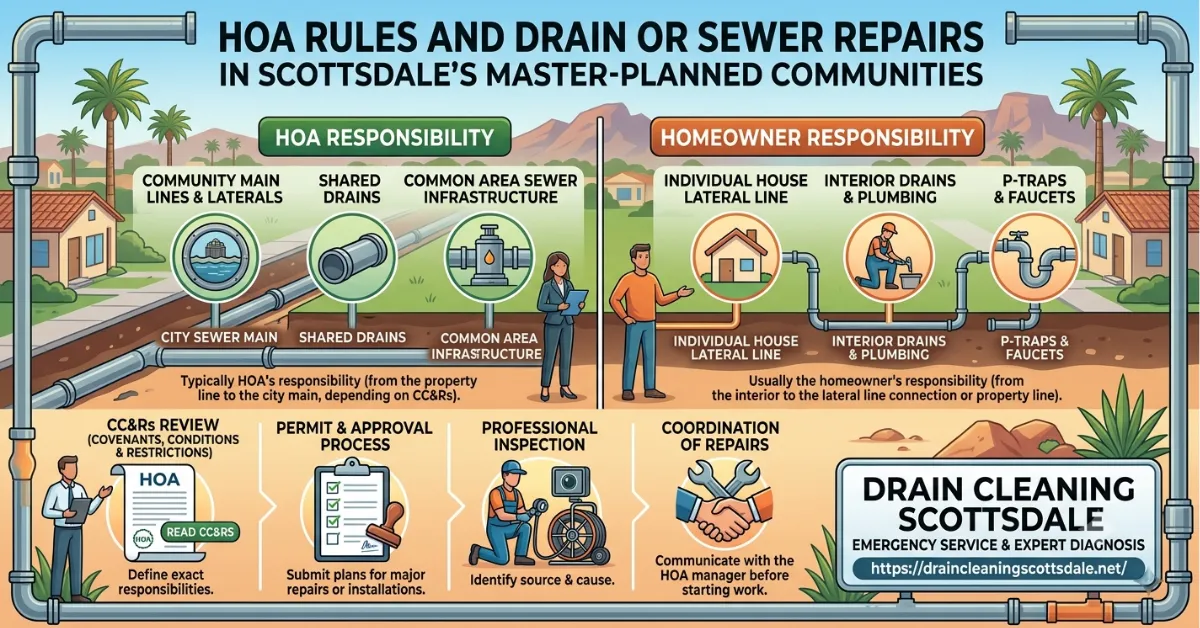
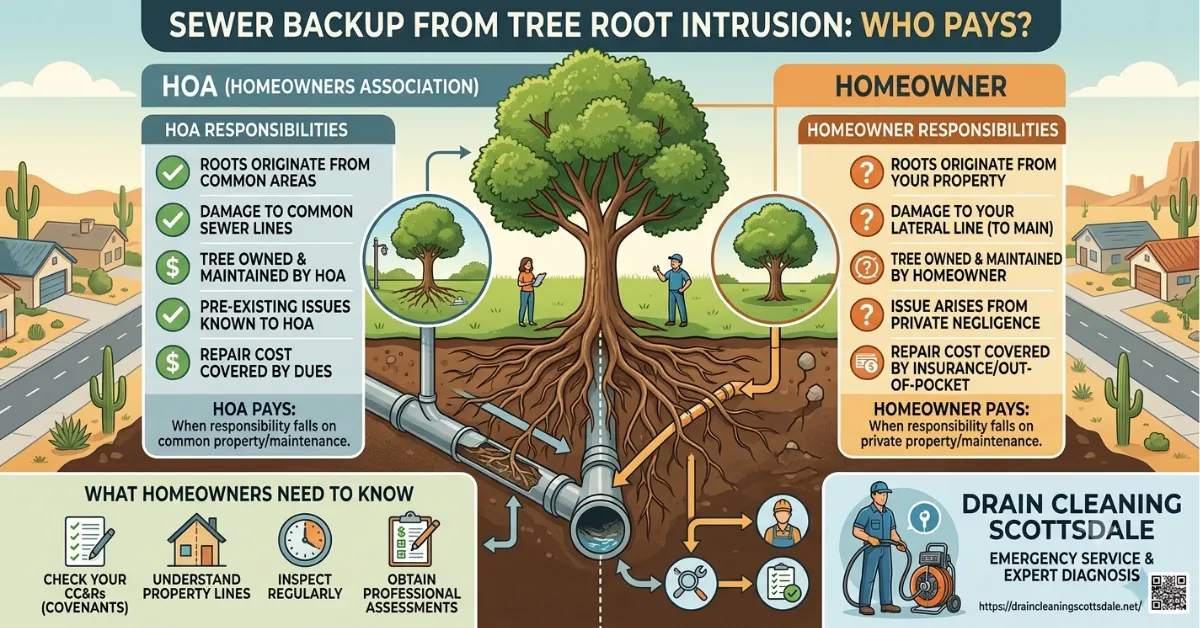
- The homeowner’s lateral line. In most cases, the portion of sewer pipe running from the house to the property line, sometimes called the lateral, is the homeowner’s responsibility, even if the tree causing the intrusion sits in a common area.
- The main sewer line. Beyond the property line, the main sewer line is typically owned and maintained by the city or a utility provider, not the HOA or individual homeowner.
- Common area landscaping. If a tree in a shared common area has roots that intrude into a specific homeowner’s private lateral, responsibility for the repair itself often still falls on the homeowner, though the HOA may share some responsibility for tree maintenance depending on its governing documents.
- Shared or community sewer systems. Some HOA communities maintain private sewer systems within common areas, in which case the HOA itself may bear more direct responsibility for backups originating in those shared lines.
- CC&R specific language. Many HOAs have specific covenants, conditions, and restrictions that address tree placement, root related damage, and maintenance responsibilities, which can shift typical assumptions in either direction.
Why This Question Comes Up So Often in Scottsdale
Established, tree lined communities throughout Scottsdale create the exact conditions that lead to this kind of dispute.
- Mature landscaping in common areas. Many Scottsdale HOA communities, including established neighborhoods like DC Ranch, have decades of tree growth in shared spaces close to individual home lots.
- Aging sewer lateral lines. Homes built years ago often have original clay or cast iron laterals that are more prone to the cracks and joint separation that let roots in to begin with.
- Proximity of trees to property lines. Community landscaping plans do not always account for the exact path of underground sewer laterals, meaning trees are sometimes planted directly above them.
- Shared irrigation near sewer lines. Regular watering of common area landscaping keeps soil consistently moist near property lines, which draws root growth toward nearby sewer laterals over time.
What to Do When a Root Related Backup Happens
Following a clear process helps protect your interests regardless of how responsibility ultimately gets sorted out.
- Address the immediate problem first. Contact a drain cleaning professional to clear the blockage and stop any active backup before worrying about who will pay.
- Get a camera inspection. A camera inspection documents exactly where the root intrusion occurred, which is often the deciding factor in responsibility discussions.
- Review your HOA’s CC&Rs. Look specifically for language about sewer lateral maintenance, tree placement responsibility, and common area landscaping obligations.
- Contact your HOA in writing. Document the issue, the camera inspection findings, and your request for clarification on responsibility, keeping a clear record of communication.
- Check your homeowners insurance policy. Some policies include sewer backup coverage as an add on, which may cover the repair regardless of the root cause dispute.
- Consult an attorney if responsibility remains unclear. For larger repair costs or ongoing disputes, a real estate or HOA attorney can review your specific documents and local law.
Signs You Need Drain Cleaning Related to Root Intrusion
These signs often appear before or during a root related sewer backup, and documenting them can support your case regardless of who ultimately pays.
- Slow draining across multiple fixtures at the same time
- Gurgling sounds from toilets or drains
- Recurring clogs that clear temporarily but return within weeks
- A sewage smell near your yard, especially over the sewer lateral path
- Unusually lush or green grass in one section of the yard
- Sinkholes or soft, sunken soil above the lateral line
Average Drain Cleaning Costs in Scottsdale
Drain cleaning cost for root intrusion depends on how extensive the growth is, the pipe material involved, and whether cleaning alone will solve the problem or a repair is needed. Most Scottsdale homeowners pay between 125 and 500 dollars for standard drain cleaning, while root related sewer line work often costs more due to the specialized equipment required.
Scottsdale Drain Cleaning Pricing Table
| Service | Typical Price Range |
|---|---|
| Sink or tub drain cleaning | 125 to 250 dollars |
| Toilet drain clearing | 100 to 225 dollars |
| Main line drain cleaning | 200 to 500 dollars |
| Hydro jetting with root cutting | 400 to 1,000 dollars |
| Sewer line camera inspection | 150 to 400 dollars |
| Sewer line cleaning or repair | 500 to 4,000 dollars |
| Trenchless pipe repair for severe root damage | 3,000 to 10,000 dollars |
| Emergency after hours service | 150 to 350 dollars added fee |
Documenting the exact cost through an itemized invoice and camera inspection report can also help support any claim submitted to an HOA or insurance provider.
Factors That Affect Drain Cleaning Cost
- Extent of root growth. A small root intrusion clears faster and cheaper than a sewer lateral packed with dense root mass.
- Pipe material. Clay and cast iron pipe require more careful handling than modern PVC when clearing roots.
- Pipe condition. Cracks or joint separation caused by roots may need repair in addition to cleaning.
- Access to the line. Root intrusion under a driveway or mature common area landscaping can require more labor to reach.
- Method required. Root cutting combined with hydro jetting costs more than a standard snake but removes the growth more thoroughly.
- Need for a camera inspection. Confirming the exact location and severity of root intrusion usually requires a camera pass, which also serves as documentation for any responsibility dispute.
Different Drain Types Involved in Root Related Disputes
Understanding which section of pipe is affected is central to figuring out who is likely responsible.
- The homeowner’s sewer lateral runs from the house to the property line and is most often the homeowner’s responsibility, even when the intruding roots originate from a common area tree.
- The municipal main sewer line sits beyond the property line and is typically maintained by the city or utility provider, not the homeowner or HOA.
- Private community sewer systems, where they exist, may place more responsibility on the HOA itself, depending on how the system was designed and documented.
- Fixture drains inside the home are rarely part of a root related dispute, since they are not connected to the shared or underground sections where roots typically intrude.
What Is Hydro Jetting
Hydro jetting is a drain cleaning method that uses high pressure water, typically 3,000 to 4,000 psi, to cut through root masses and clear debris from the interior of a pipe without relying on chemicals.
For root intrusion specifically, hydro jetting is often combined with a mechanical root cutting attachment, allowing a technician to both cut through the root mass and flush the remaining debris out of the line in the same service visit.
Sewer Line Cleaning
Sewer line cleaning addresses the main pipe connecting your home to the municipal sewer system, which is exactly where tree root intrusion most commonly occurs and where documentation matters most for responsibility questions.
A typical Sewer Line Cleaning service for root intrusion includes:
- A camera inspection to locate the root mass and assess pipe condition
- Mechanical root cutting to clear the blockage
- Hydro jetting to flush remaining debris from the pipe
- A follow up camera pass to confirm the line is clear and document any resulting damage
Keeping a copy of the camera inspection report and service invoice gives you clear documentation if you need to pursue reimbursement from your HOA or insurance provider afterward.
Camera Inspections
A camera inspection sends a waterproof camera through your pipes to show the exact location, size, and density of root intrusion, along with any resulting cracks or joint separation.
Camera inspections are especially important for HOA related disputes because they help confirm:
- Whether the root intrusion originated on your side of the property line or beyond it
- How far the root growth extends along the lateral
- If pipe damage caused by the roots requires trenchless repair or replacement
- Whether a specific common area tree is the clear source, which can support a claim to the HOA
Emergency Drain Cleaning
How do I know if I have a drain emergency? If sewage is backing up into multiple fixtures, water is pooling in your yard above the sewer lateral, or you experience a sudden and complete loss of drainage, that is a plumbing emergency that needs immediate attention rather than a scheduled visit.
Situations that call for Emergency Drain Cleaning related to root intrusion include:
- A previously known root issue that suddenly causes a complete blockage
- Sewage backing up into a tub, shower, or floor drain
- Sudden sinking or soft soil above the sewer lateral path
- Multiple drains backing up at the same time with no other explanation
Address the emergency first, then work through the responsibility question afterward using the documentation from your service call.
Residential and Commercial Drain Cleaning Services
Root intrusion affects residential HOA communities and commercial properties differently based on landscaping and ownership structure.
Residential drain cleaning for root intrusion typically focuses on individual sewer laterals near mature common area trees in HOA communities throughout Scottsdale, including neighborhoods like DC Ranch.
Commercial drain cleaning covers larger diameter lines on properties with established landscaping, such as office parks or retail centers managed by a property association, where responsibility questions can involve a management company rather than an individual HOA board.
Cost Saving Tips for Homeowners in HOA Communities
A few proactive steps can help you avoid a costly dispute later.
- Request a camera inspection at the first sign of a slow drain or recurring clog, before a full backup happens.
- Keep copies of all HOA communications, invoices, and inspection reports related to any root intrusion issue.
- Review your HOA’s CC&Rs for tree placement and maintenance language before a dispute arises, not after.
- Ask your HOA about any existing root barrier policies near common area trees close to individual lots.
- Check your homeowners insurance policy for sewer backup coverage as an add on, which may simplify the cost question entirely.
- Consider raising landscaping and root barrier concerns at an HOA meeting proactively if you know mature trees are close to your sewer lateral.
Why Scottsdale Homes Experience Drain Issues
Beyond root related HOA disputes, several broader conditions contribute to drain problems across Scottsdale.
- Expansive clay soil. Soil across the Scottsdale area shifts with seasonal moisture, stressing underground pipes and creating the cracks that roots later exploit.
- Extreme summer heat. High temperatures can dry out soil and shift ground conditions, sometimes accelerating pipe joint separation.
- Hard water mineral buildup. Scottsdale’s water supply contributes to scale buildup inside pipes, which can combine with root intrusion to worsen blockages.
- Established, tree lined HOA communities. Communities like DC Ranch have both the mature landscaping and the pipe age that make root intrusion more likely than in newer developments.
- Aging pipe materials. Clay and cast iron sewer laterals installed decades ago remain more vulnerable to root intrusion than the PVC used in newer construction.
Why Professional Drain Cleaning Is Worth the Cost
A licensed drain cleaning professional does more than clear the immediate blockage. Camera documentation from a proper inspection gives you the evidence needed to have a clear, fact based conversation with your HOA rather than relying on guesswork about where the intrusion actually occurred.
Professional service also protects your property from repeat problems. Left unaddressed, root intrusion can crack or collapse a sewer lateral entirely, leading to costly excavation and repair that far exceeds the price of routine root cutting and documentation. Investing in a proper inspection now supports both the immediate fix and any future responsibility discussion.
Conclusion
A sewer backup caused by tree root intrusion in an HOA community raises a fair question about who should pay, and the honest answer is that it depends on your specific governing documents, where the intrusion occurred, and local law. What you can control is getting the problem fixed quickly and documented thoroughly with a proper camera inspection, which puts you in the strongest position no matter how the responsibility conversation unfolds. If tree roots have caused a backup in your Scottsdale home, reach out to a local drain cleaning team who can clear the line and give you the documentation you need moving forward.
Frequently Asked Questions
Is the HOA responsible for sewer damage from common area tree roots? It depends on your HOA’s governing documents and where the damage occurred. Homeowners are typically responsible for their own sewer lateral even if a common area tree is the source, though this varies and is not legal advice.
How do I know if I have a drain emergency caused by tree roots? If sewage is backing up into multiple fixtures, water is pooling in your yard above the sewer lateral, or drainage suddenly stops completely, that is an emergency requiring immediate attention.
What is a sewer lateral and why does it matter for responsibility questions? A sewer lateral is the pipe running from your home to the property line, and it is the section most often considered the homeowner’s responsibility, regardless of where the intruding roots originated.
Should I get a camera inspection before contacting my HOA about root damage? Yes, a camera inspection provides clear documentation of where the root intrusion occurred, which is often central to any conversation about shared or HOA responsibility.
Does homeowners insurance typically cover tree root sewer damage? Some policies include sewer backup coverage as an add on, but this varies significantly by provider and policy, so reviewing your specific coverage or speaking with your insurance agent is the best way to know for certain.
Can I make my HOA remove a tree causing root intrusion? This depends entirely on your HOA’s governing documents and local law, so reviewing your CC&Rs or consulting an attorney is necessary to understand your specific options.
What should I do first if I suspect root intrusion is causing a backup? Address the immediate blockage with a professional drain cleaning service, then request a camera inspection to document the cause before pursuing any responsibility discussion.
Is hydro jetting safe for removing tree roots from an older sewer lateral? When combined with a camera inspection to confirm pipe condition first, hydro jetting paired with root cutting is generally safe and effective, even in older clay or cast iron laterals.
How much does it typically cost to fix a sewer lateral damaged by tree roots? Costs range from a few hundred dollars for root cutting and cleaning to several thousand dollars for trenchless repair if the roots have caused significant pipe damage.
Should I talk to a lawyer about a sewer backup dispute with my HOA? For larger repair costs or unresolved disputes, consulting a real estate or HOA attorney who can review your specific documents and local law is generally a reasonable next step.